
Internal Pipe Scanning
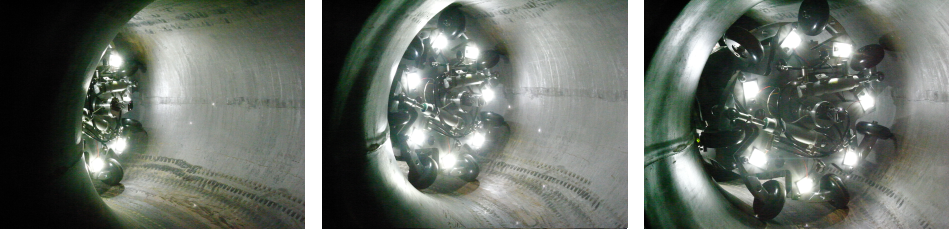
Buried Pipe Inspection
For the inspection of buried pipework in industrial plants like tank to tank connections in refineries and storage plants, street, railway or river crossings, cooling water pipes in nuclear and thermal power plants, pressure pipes in electro-hydraulic power plants, etc. testing systems with particular features are required. From the design those pipeworks generally are not foreseen to be piggable. Therefore the following situations can occur:
- A launching/receiving station is not existing. Therefore for insertion of the tool only a short pipe section or an armature can be removed.
- In many cases access into the pipe is possible only from one end. The tool must allow bi-directional movement.
- The pipework has short bends with radiuses down to 1.5 × D.
- In many cases the pipes are coated on the inner surface by rubber, GRP or concrete.
- A comprehensive cleaning prior to the inspection is not possible. The surface can be covered by residue from the product, scaling, etc.
- The pipes can only be tested without medium. The use of water or other coupling liquids in many cases is unwanted.
KontrollTechnik GmbH has developed the SLOFEC® umbilical pipe inspection tools, type PLM and type PLS. Both scanner types have a modular design, which can easily be adapted to the situation on site. The design features of the SLOFEC® pipe inspection tools and advantages of the SLOFEC® technique are as follows:
- The SLOFEC® pipe inspection tool consists of single modules, which are connected by flexible joints. Each module is minimized in length allowing the tool to pass narrow bends.
- The modules of the tools can be assembled on site. Even if due to limited access only modules or parts of the tool can be inserted in the pipe, in many cases the assembly inside the pipe is possible.
- Each SLOFEC® pipe inspection tool can be moved bi-directionally using a crawler system or pulled through the pipe by means of a winch.
- The SLOFEC® pipe inspection tool type PLS has retractable centering devices and a retractable sensor head to pass sections with a reduced diameter.
- The SLOFEC® technique is very sensitive to local corrosional attack.
- The SLOFEC® technique can test through non-conductive coatings up to 10 mm thickness.
- The SLOFEC® technique needs no coupling liquid.
- The SLOFEC® technique is insensitive to residues.
SLOFEC® Internal Pipe Scanner Type PLM
The SLOFEC® Internal Pipe Scanner Type PLM is designed as a drive-through unit either connected to a crawler system or pulled by a winch. The sensors are spring loaded and arranged between the poles of the magnetization unit. The complete sensor head is guided on wheels for low friction and bi-directional operation. The advantage of the PLM type scanner is the applicability for the inspection of pipes with relatively small diameters and the rather high inspection speed.
Technical features
| Pipe diameter range | 10″ – 30″ (for each pipe diameter an adapted sensor unit has to be used) |
|---|---|
| Pipe wall thickness range | up to 12.0 mm (depending on detection limit and coating thickness) |
| Max. coating thickness | up to 10 mm (depending on detection limit) |
| Max. inspection length | up to 150 m (foreseen 400 m) |
| Sensor coverage | up to 32 sensors for 360° of pipe circumference |
| Minimal passable bend radius | 1.5 × D |
| Max. data acquisition speed | 3 m per minute |
| Sensor head weight | 80 kg – 280 kg (depending on size) |
| Drive propulsion system | electro-motor driven crawler modules or pulled by wire |
| Max. diameter reduction | reduction of approx. 5–10 % of the nominal pipe diameter can be passed |
| Axial signal position | determined by an odometer wheel |
| Circumferential signal position | not possible in the current models |
Advantages and limitations
Advantages:
- 360° coverage at axial movement
- high testing speed
- passage of small bends
- inspection of the bend zone is possible
Limitations:
- high unit weight for big diameter tools
- relatively small resolution in circumferential direction
- butt welds and an area of approx. 50 mm to either side of butt welds remain untested due to the noise signal from the weld
- restrictions in the passage of sections with reduced diameter
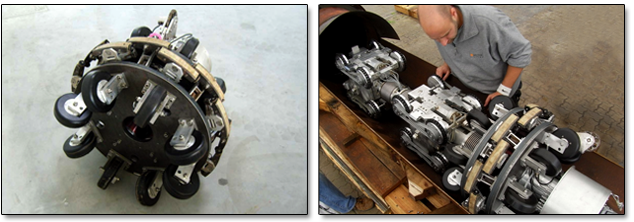
PLM type scanner
SLOFEC® Internal Pipe Scanner Type PLS
The SLOFEC® Internal Pipe Scanner Type PLS is a scanner unit with a rotating sensor head. The scanner unit is designed to be connected either to a crawler system or pulled by a winch. For data acquisition the scanner will be positioned by the crawler or winch in axial direction. In position the sensor head will be radially pressed against the pipe wall by means of pneumatic or hydraulic cylinders and moved in circumferential direction. After completion of a complete circumferential scan, the sensor heads will be retracted and the complete pipe testing unit will be moved one sensor head width in axial direction. In this position the data acquisition procedure will be started again. The scanning procedure is fully automated to reach reasonable inspection velocities.
The complete sensor head is guided on wheels for low friction and bi-directional operation. The centering devices can be expanded and folded to pass sections with reduced diameter. The advantages of the PLS type scanner are the reduced weight compared to the PLM type scanner, especially for bigger diameters, the higher resolution and the reduced dead zones at butt welds or pipe connections.
Technical features
| Pipe diameter range | ≥ 20″ (for each pipe diameter an adapted sensor unit has to be used) |
|---|---|
| Pipe wall thickness range | up to 18.0 mm (depending on detection limit and coating thickness) |
| Max. coating thickness | up to 10 mm (depending on detection limit and pipe wall thickness) |
| Max. inspection length | up to 300 m (foreseen 500 m) |
| Sensor coverage | up to 8 sensors for an axial scanning width of 150 mm, 360° of pipe circumference for each rotation |
| Minimal passable bend radius | 1.5 × D |
| Max. data acquisition speed | 100 m per shift |
| Sensor head weight | 60 kg – 100 kg (depending on size) |
| Drive propulsion system | electro-motor driven crawler modules or pulled by wire |
| Max. diameter reduction | reduction of approx. 25 % of the nominal pipe diameter can be passed |
| Axial signal position | determined by an odometer wheel |
| Circumferential signal position | determined by a gravity sensor and odometer wheel |
Advantages and limitations
Advantages:
- small unit weight even for big diameter tools
- high resolution in circumferential and axial direction
- no dead zones at either side of butt welds
- for even shaped butt welds testing of the weld itself is possible
- less restriction in the passage of diameter reductions compared to the PLM type scanner
Limitations:
- reduced testing speed compared to the PLM type scanner
- passage of small bends may not be possible (mainly for small pipe diameters)
- inspection of the bend zones is limited
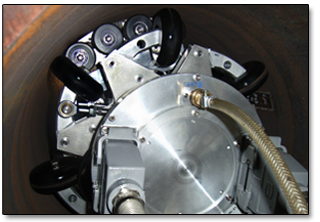
PLS type scanner
SLOFEC® Internal Pipe Scanner Type PLS-M
The SLOFEC® Internal Pipe Scanner Type PLS-M has the same working principle as the PLS type tool. The difference is that the PLS-M unit is designed for the inspection of pipes where personal access inside the pipe is possible or where the unit can be pulled by a winch. The operation in combination with a crawler system is not planned in this design.
Technical features
| Pipe diameter range | ≥ 30″ |
|---|---|
| Pipe wall thickness range | up to 18.0 mm (depending on detection limit and coating thickness) |
| Max. coating thickness | up to 10 mm (depending on detection limit and pipe wall thickness) |
| Max. inspection length | up to 250 m (foreseen 400 m) |
| Sensor coverage | up to 8 sensors for an axial scanning width of 150 mm, 360° of pipe circumference for each rotation |
| Minimal passable bend radius | 3 × D (1.5 × D in case of personal access) |
| Max. data acquisition speed | approx. 50 m per shift |
| Total scanner weight | 170 kg |
| Drive propulsion system | manual or pulled by wire |
| Max. diameter reduction | reduction of approx. 25 % of the nominal pipe diameter can be passed |
| Axial signal position | determined by an odometer wheel |
| Circumferential signal position | determined by a gravity sensor and odometer wheel |
Advantages and limitations
Advantages:
- small unit weight even for big diameter tools
- high resolution in circumferential and axial direction
- no dead zones at either side of butt welds
- for even shaped butt welds testing of the weld itself is possible
- less restrictions in the passage of diameter reductions compared to the PLM type scanner
- installation through manholes is possible
Limitations:
- reduced testing speed compared to the PLM type scanner
- passage of small bends may not be possible (mainly for small pipe diameters)
- inspection of the bend zones is limited
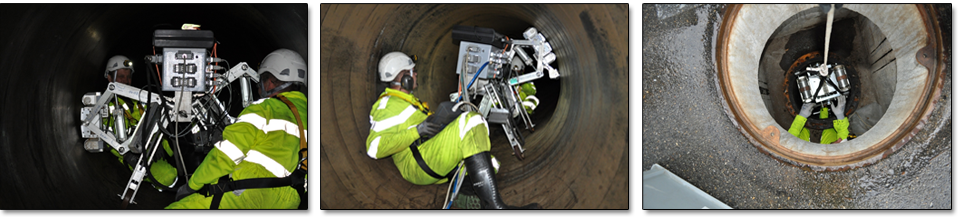
PLS-M type scanner
Internal Pipe Scanner Type PLM-S.MB and PLM-S.RF
The Internal Pipe Scanners Type PLM-S.MB and PLM-S.RF are designed as drive-through probes for the inspection of small diameter pipes. The scanners are either pulled through a pipe section by a winch or by the signal cable.
In both types the sensors are spring loaded and arranged between the poles of the magnetization unit (Type PLM-S.MB) respectively the transmitter coils (Type PLM-S.RF) to pass sections with diameter reductions. The advantages of the PLM-S.MB and PLM-S.RF type scanners are the applicability for the inspection of pipes with relatively small diameters and the rather high inspection speed.
Technical features
| Pipe diameter range | 1″ – 10″ (for each pipe diameter an adapted sensor unit has to be used) |
|---|---|
| Pipe wall thickness range | up to 8.0 mm (depending on detection limit and coating thickness) |
| Max. coating thickness | up to 4 mm (depending on detection limit) |
| Max. inspection length | up to 300 m |
| Sensor coverage | up to 32 sensors for 360° of pipe circumference |
| Minimal passable bend radius | > 1.5 × D (Type PLM-S.RF), > 3.0 × D (Type PLM-S.MB); depends on pipe diameter and wall thickness |
| Max. data acquisition speed | 6 m per minute |
| Sensor head weight | 20 kg – 50 kg (depending on size) |
| Drive propulsion system | pulled by wire |
| Max. diameter reduction | reduction of approx. 5–10 % of the nominal pipe diameter can be passed |
| Axial signal position | by odometer wheel attached to the pulling winch or by time dependent data acquisition at constant pulling speed |
| Circumferential signal position | not possible |
Advantages and limitations
Advantages:
- 360° coverage at axial movement
- high testing speed
- inspection of the bend zone is possible
Limitations:
- relatively small resolution in circumferential direction (depending on pipe diameter)
- butt welds and an area of approx. 50 mm to either side of butt welds remain untested due to the noise signal from the weld
- restrictions in the passage of sections with reduced diameter
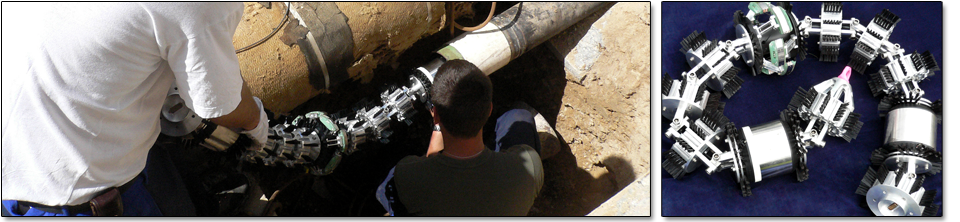
PLM-S.RF type scanner
Result Documentation
Section report
The result documentation consists of colored pipe section reports and a feature list. In the “Pipe Scan Report” for each tested pipe section wall thickness reductions will be shown in a 2D-scan color image, where the defect depth corresponds to a defined color.
Indication list
The “Indication List” shows the evaluated depth, position, size and identification as internal or external defect.
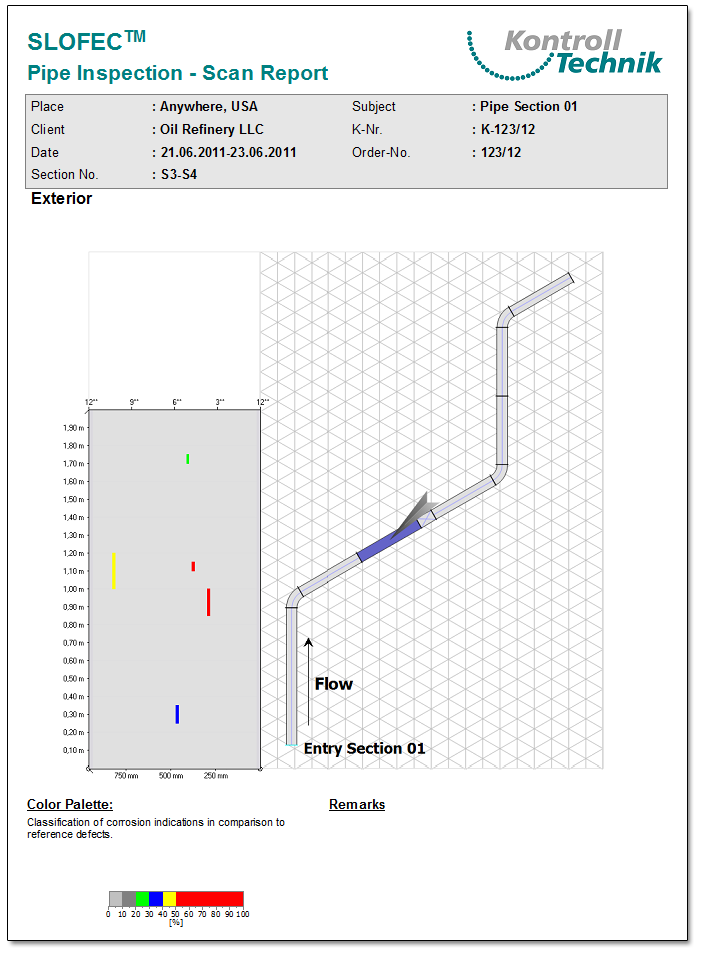
Example for a pipe section report
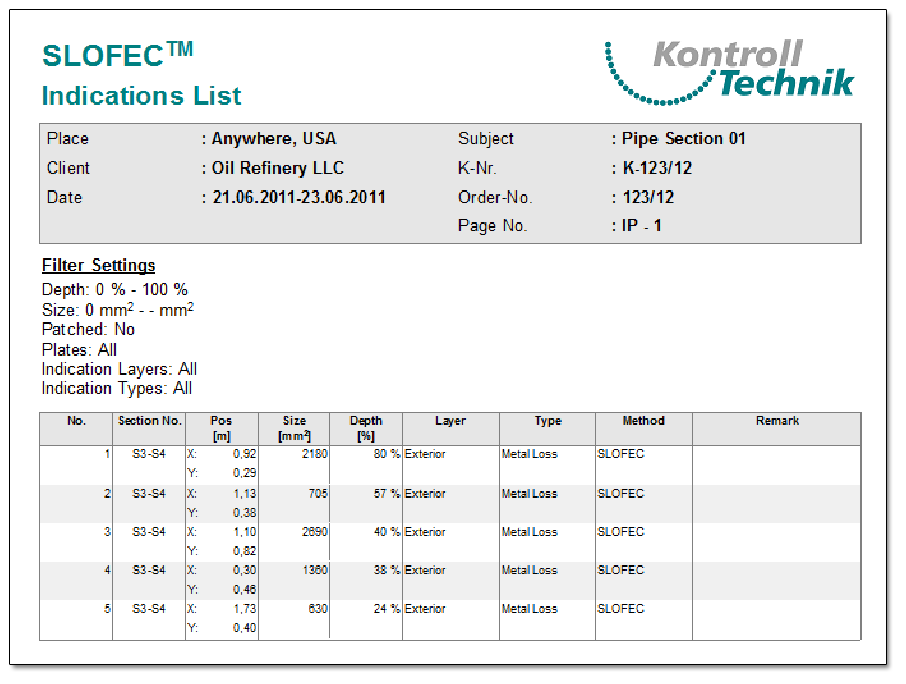
Example for an indication list